8 Best Ecommerce Analytics Tools in 2026
Running an online store means you deal with numbers every day, like website visits, clicks, and sales.
You can’t do much with these numbers without the right tools to turn them into actionable insights.
That’s where ecommerce analytics tools become essential.
These tools collect and organize data about your ecommerce store’s performance, giving you a connected view across your entire operation, from the first click on a social media ad to the follow-up customer journey through your product.
This guide will walk you through the best ecommerce analytics tools to see what’s working and what isn’t, so you can refine your marketing strategy and deliver better customer experiences.
Let’s find you a tool that doesn’t just add more data to your day but provides clear guidance for your daily decisions.
What are Ecommerce Analytics Tools?
Ecommerce analytics tools are software solutions that show you how people interact with your online store.
These tools gather data from all your marketing channels, including your website, ads, and email campaigns, to help you answer critical business questions like:
- Which products sell well?
- Where do your visitors come from?
- How many complete a purchase?
- What stops them from buying?
They connect anonymous visits to specific customer actions that are directly tied to your revenue.
They provide many benefits for your ecommerce business:
- Smart Marketing Decisions: Instead of spending money on ads without knowing if they work, analytics tools show you which marketing campaigns bring traffic and sales. You can then put your budget where it matters.
- Better Customer Insights: Analytics tools give you a clear view of who your buyers are and how they behave. You learn what products they like, how long they spend on pages, and what paths they take before buying. This helps you match your products to real customer needs and optimize conversion rates.
- Save Time on Reporting: Instead of spending days each week manually building reports in spreadsheets, you get a live, accurate dashboard. This redirects your team’s focus from data collection to action.
- Inventory and Product Management: By connecting product performance to marketing and inventory costs, you can identify your best-sellers, decide stock levels, avoid overselling, and plan promotions more accurately.
- Grow Your Business: Analytics reveal patterns and trends that help you plan for the future. You can see seasonal sales, customer preference, and how performance changes after updates or new features go live.
Top 8 Ecommerce Analytics Software
Now, let’s look at the best ecommerce analytics platforms, including their key features, pros and cons, and where each one works best, to help you find the right tools for your needs.
Vemetric
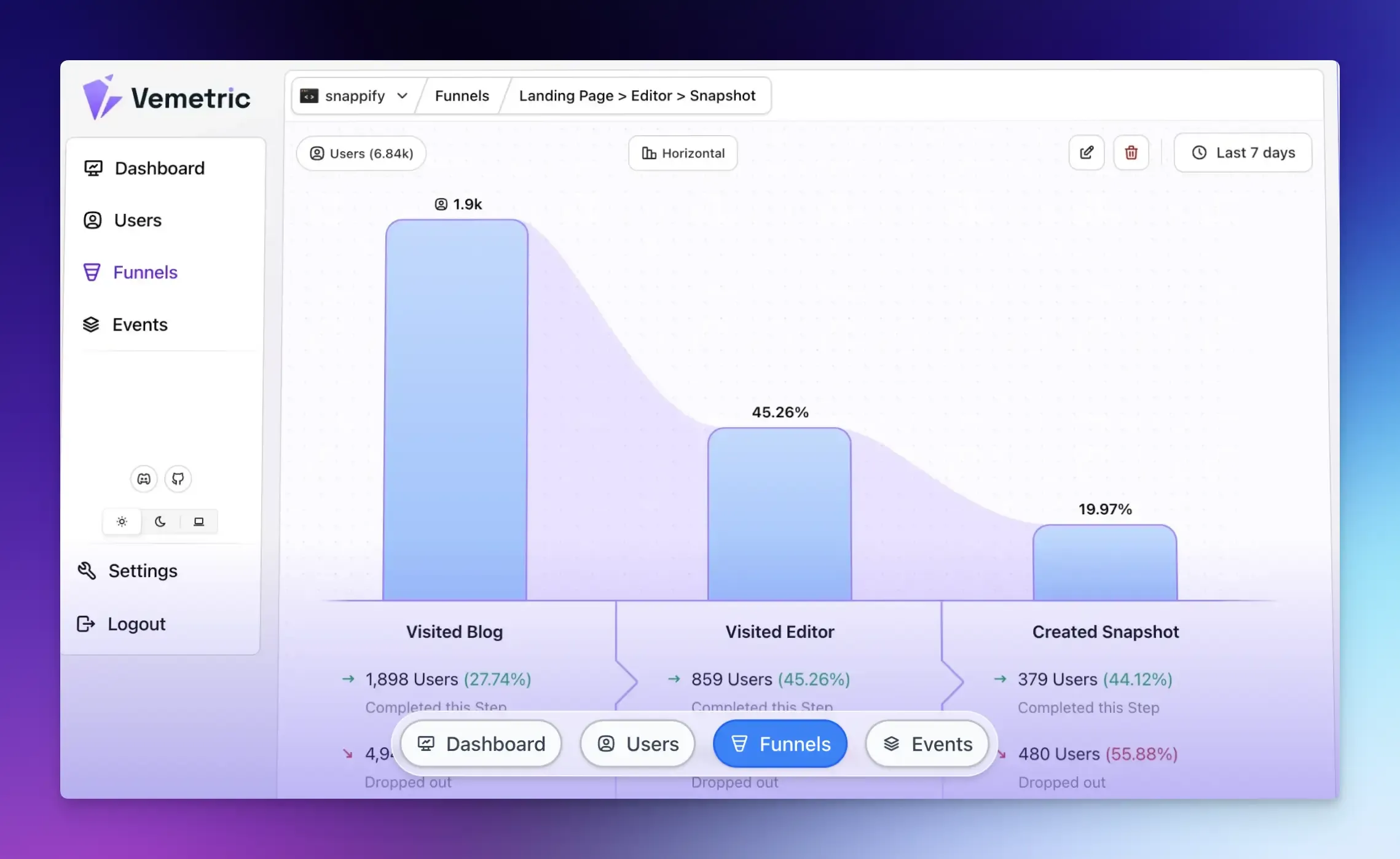
Vemetric is an open-source, privacy-first web and product analytics tool that helps you see how people use your website or product.
For ecommerce brands, it tracks each user’s journey and shows real-time activity streams. You can see the path each buyer followed, which product pages they visited, where they dropped off without buying, and how different user groups convert over time.
It is designed to be simple to use while giving you powerful insights, and it takes data privacy very seriously by not using cookies by default. If you need to use cookies, that option is available as opt-in.
Best for: Ecommerce businesses and product teams that prioritize data privacy and need to understand detailed customer behavior journeys without relying on cookie tracking.
Key Features:
- Web Analytics: Track key customer engagement metrics for your ecommerce website.
- User Journeys: See individual user actions in sequence to find patterns in customer behavior.
- Custom Event Tracking: Define specific events, such as button clicks or feature usage, to track user interactions.
- Funnels: Visualize drop-off points and conversion steps.
- Event Streams: View a live feed of every action happening on your site in chronological order.
- Activity Heatmap: Monitor which product images or add-to-cart buttons get the most attention.
Pros:
- Strong privacy and GDPR compliance.
- Open source analytics.
- Merges anonymous browsing with logged-in activity, which is useful for ecommerce.
Cons:
- Self-hosting isn’t available yet (a community edition is in development).
Pricing:
- Free plan available.
- Paid plan starts at $5 per month.
Google Analytics 4
Google Analytics 4 (GA4) is the industry-standard web analytics platform from Google. It provides the starting point for analyzing website traffic, customer acquisition, and conversion tracking, making it essential for marketers and advertisers.
Best for: All ecommerce businesses that want web analytics and tracking tied to marketing campaigns.
Key features:
- Event-based tracking for specific user actions and insights.
- Cross-platform user journeys across different devices and sessions.
- Marketing attribution across multiple touchpoints (like ads, emails, social media).
- Explorations and custom reports using segments and conversion funnels.
- Integration with Google Ads and other Google tools.
Pros:
- Free for standard use.
- Large support community and documentation.
- Good at basic web and campaign analytics.
Cons:
- Not purpose-built for ecommerce revenue modeling.
- Learning curve for deeper custom reports.
Pricing: Free (with optional enterprise GA4 360 at very high pricing).
Cometly
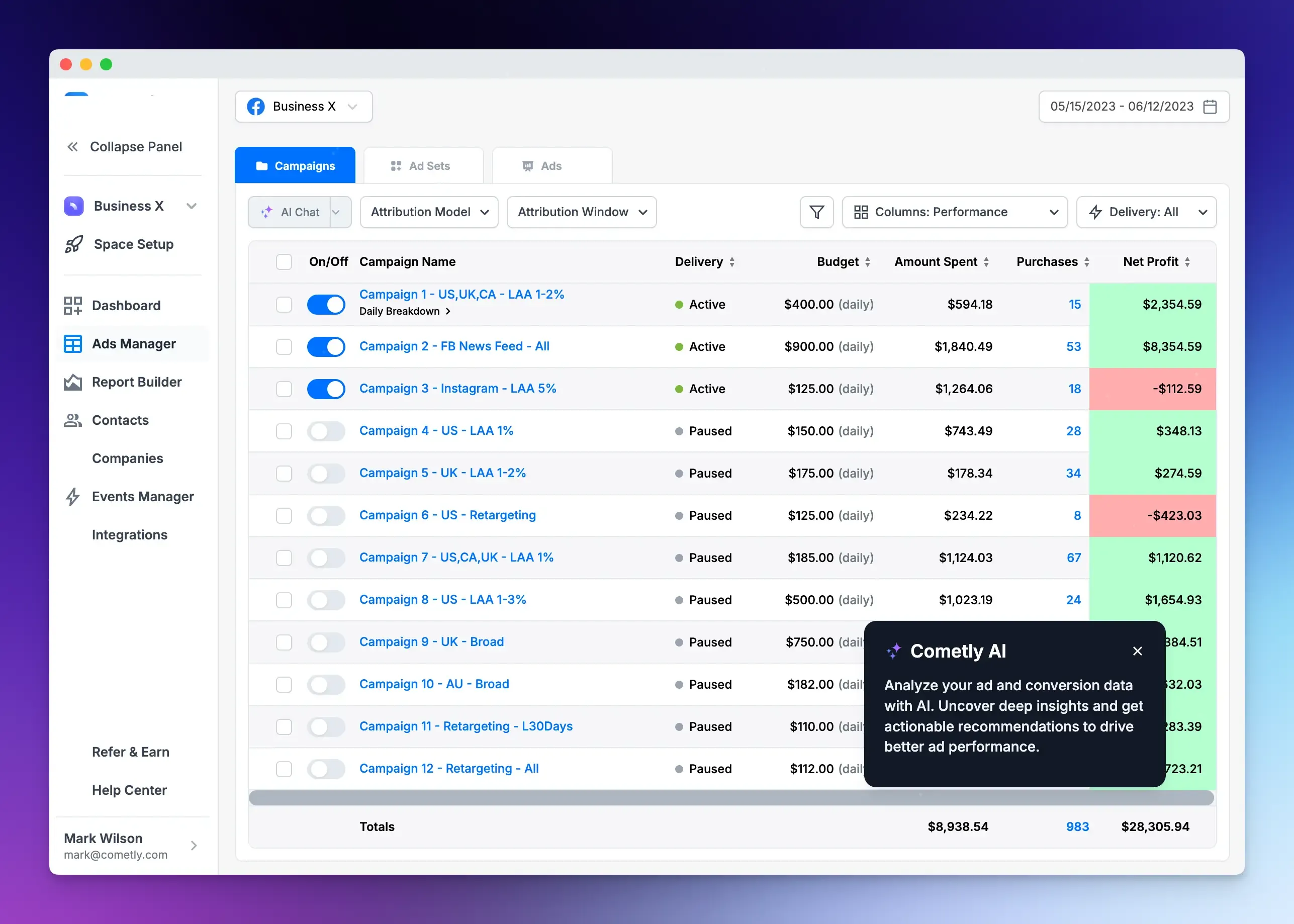
Cometly is a marketing attribution and analytics platform that helps ecommerce businesses track how their paid ads, email channels, and other marketing efforts lead to sales and conversions.
It centralizes data from platforms like Meta and Google to give you a single, accurate view of your customer’s journey and marketing performance.
You can use this data to optimize your ad campaigns with AI recommendations for budget adjustments.
Best For: Ecommerce brands and marketing teams that need to connect ad spend directly to revenue.
Key Features:
- Multi-touch attribution, including first touch, last touch, linear, and more.
- Server-side tracking and one-click conversion sync to ad platforms.
- Funnels, customer journeys, and activity-based event tracking.
- Customizable dashboards and reports to break down performance by product, channel, campaign, or region.
- Integration with ecommerce platforms like Shopify, WooCommerce, HubSpot, Salesforce, and email services.
Pros:
- More reliable than basic ad platform reporting.
- Get all your performance data in one place.
Cons:
- Pricing is based on monthly ad spend, so it scales with your budget.
- Setting up detailed attribution or advanced tracking can take time.
Pricing: Tiered plans start at $199/month, and cap monthly ad spend at $20k.
Triple Whale
Triple Whale is an all-in-one analytics and attribution platform for direct-to-consumer (DTC) ecommerce brands.
It connects to all the tools you use, such as marketing, sales, operations, and more, and uses its own first-party tracking code on your website to build a more accurate picture of the customer journey.
Best for: Shopify and DTC brands focusing on marketing performance and attribution.
Key Features:
- Central dashboard for revenue, ads, and customer analytics.
- Marketing attribution to show which ads and channels deliver value.
- Marketing mix modeling and an AI assistant for automated insights and trend spotting.
Pros:
- Easy setup with pre-built dashboards.
- Good for revenue, conversion, and campaign tracking.
Cons:
- Some advanced features cost more.
- Primarily for DTC/Shopify Brands.
Pricing:
- Free plan available.
- Paid plans start at $129/month.
Mixpanel
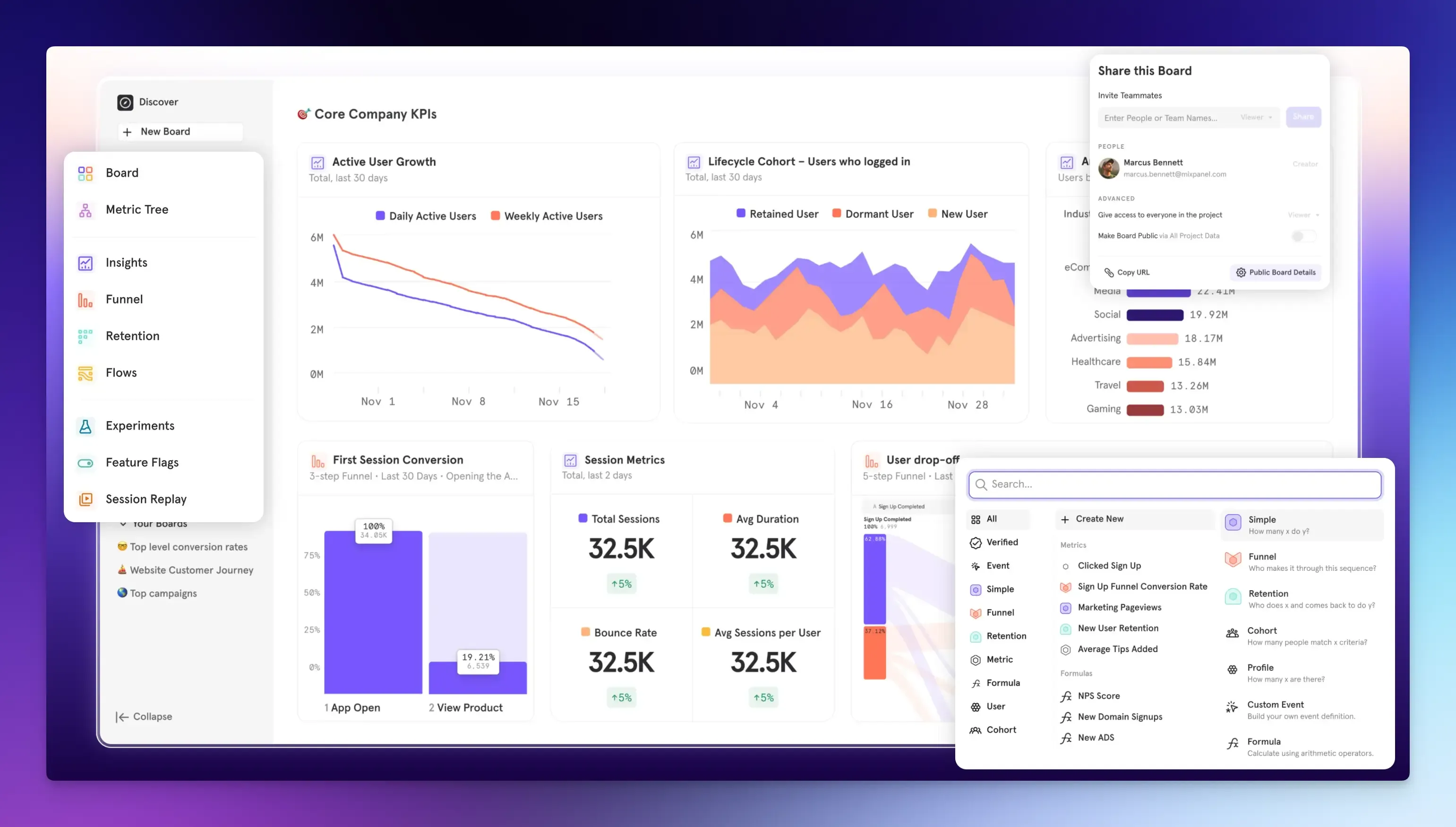
Mixpanel is an event-based analytics platform that shows you how customers use your digital product or website through funnel analysis, cohort retention reports, and session replays.
Best For: Product and growth teams at scaling ecommerce businesses.
Key Features:
- Event-based tracking with detailed funnel and retention analysis.
- Powerful segmentation, cohort analysis, and reporting with custom dashboards.
- Session replays to see real user sessions on your site.
Pros:
- Self-serve analysis for deep behavioral insights.
- Offers a generous free tier for smaller volumes.
Cons:
- It can become expensive at scale based on event volume.
- Less focused on financial metrics, such as overall profitability.
Pricing: Offers 1 million monthly events free. After that, usage-based pricing costs approximately $0.28 per 1,000 events.
Glew
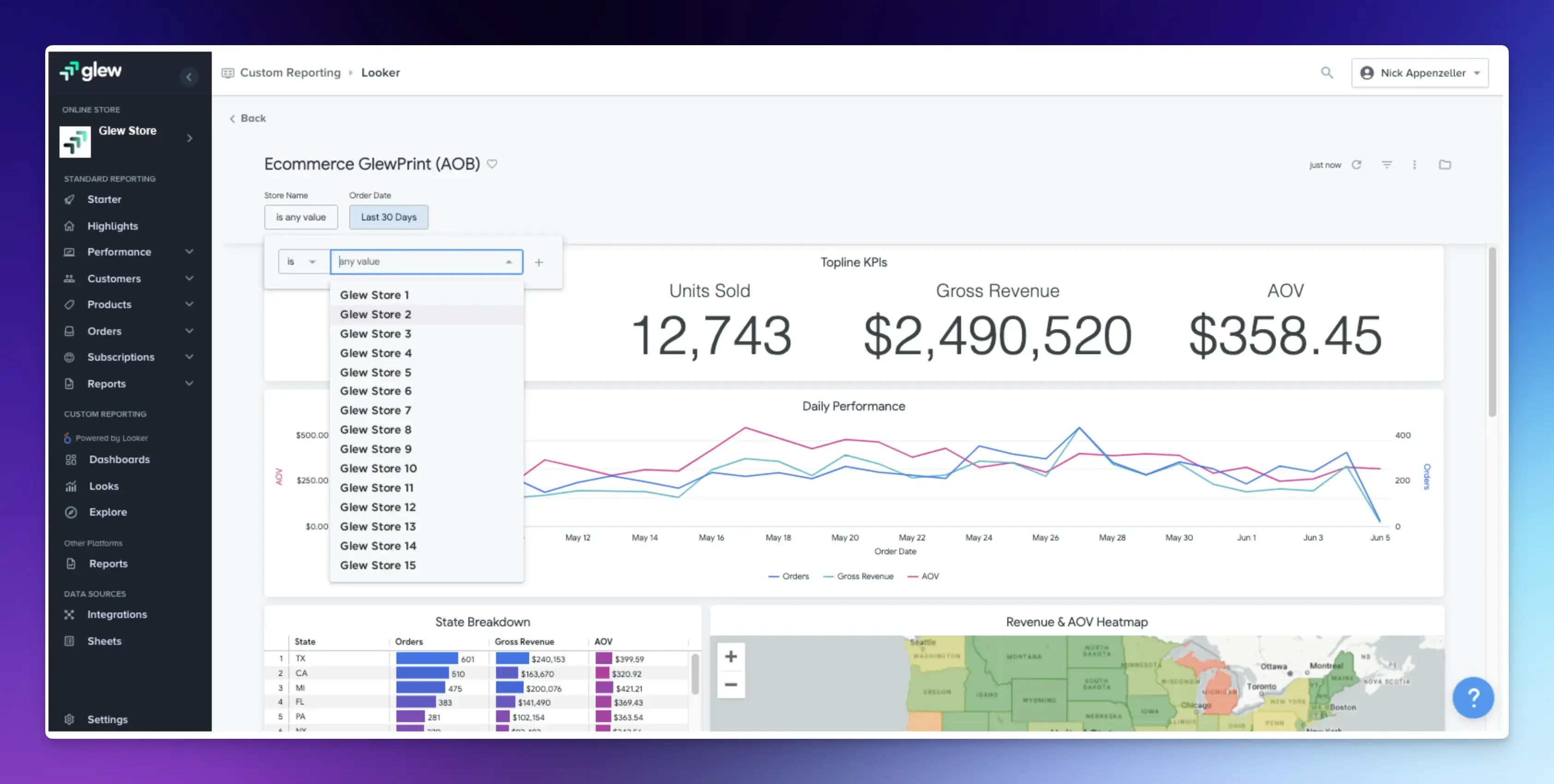
Glew is a comprehensive ecommerce analytics tool that pulls data from all your different sales channels, marketing tools, and back-end systems into one place.
It offers a managed data pipeline (ELT) and an extensive library of pre-built integrations, enabling users to integrate and work with data from dozens of sources.
Best for: Ecommerce stores and agencies that need multi-channel visibility.
Key features:
- Automated daily email snapshot and reports with the most important KPIs.
- Customer segmentation and cohort analysis based on behavior, purchase history, or other attributes.
- Product and inventory analytics to understand performance, profit margins, and inventory health.
- Custom reporting across marketing, customer, and product data.
Pros:
- Integrates with popular ecommerce and marketing platforms.
- Pre-built dashboards for common metrics, including LTV, profit, and customer segments.
Cons:
- Pricier than simpler analytics tools.
- It might be too much for small stores.
Pricing: Custom quotes based on features and needs.
Lifetimely
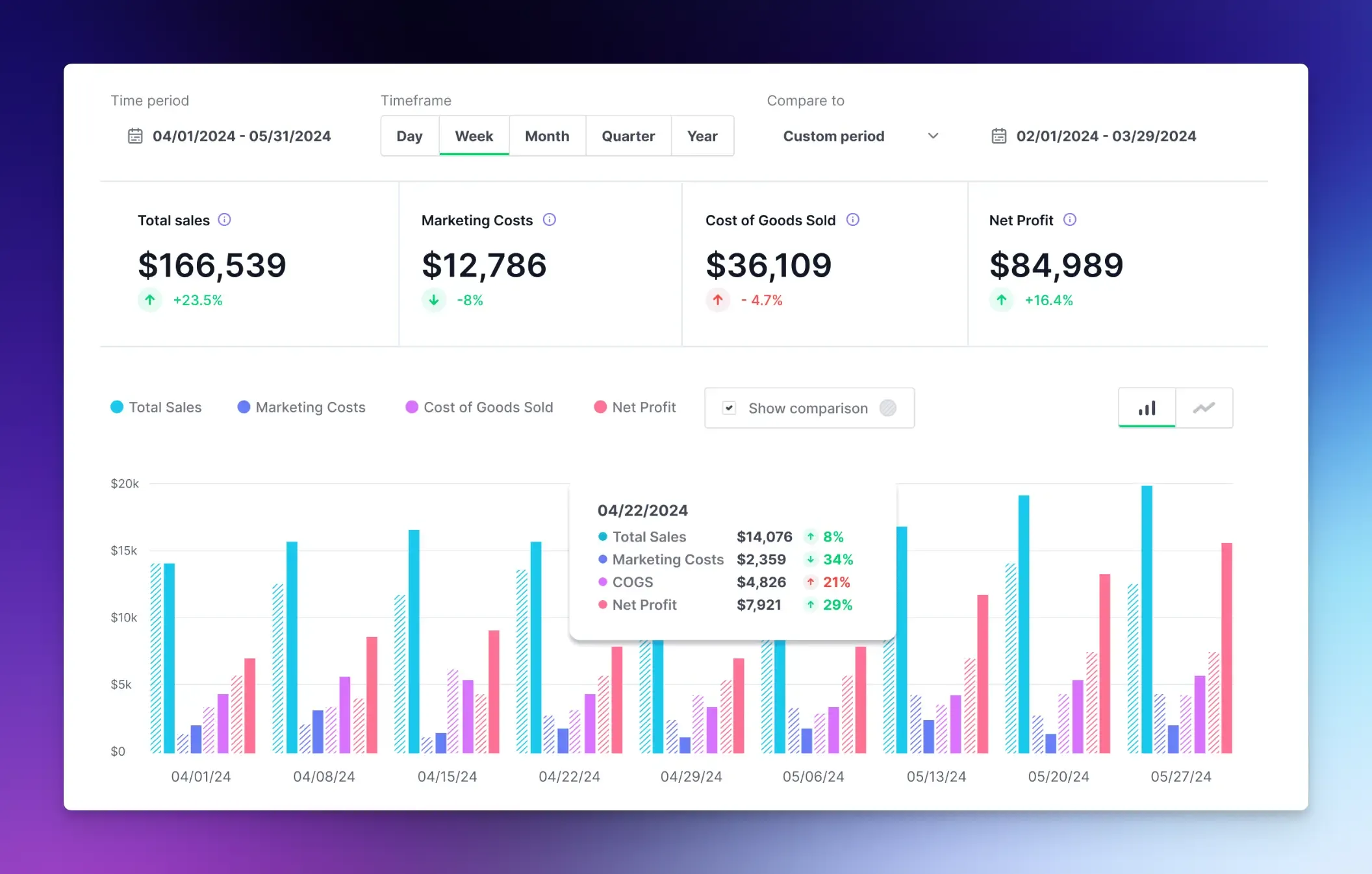
Lifetimely is a product analytics tool focused on customer acquisition cost, lifetime value, retention, and other ecommerce metrics.
It is particularly good at revealing the long-term value of different customer groups and the true net profit of your business by combining revenue, product costs, marketing spend, shipping, and other expenses in real time.
Best for: Shopify-focused DTC brands looking to understand repeat-purchase behavior.
Key features:
- A profit-and-loss dashboard that automatically provides a daily snapshot of your business health.
- Deep LTV reports and cohort analysis based on purchase history and habits.
- Customer behavior and journey analytics with multi-channel attribution.
- Predictive LTV modeling using historical data and industry trends.
Pros:
- Quick setup and affordable for entry-level.
- Good for basic retention and value insights.
Cons:
- Lacks deeper product analytics or attribution features.
- Limited marketing integration.
Pricing: Starts from $149 per month.
StoreHero
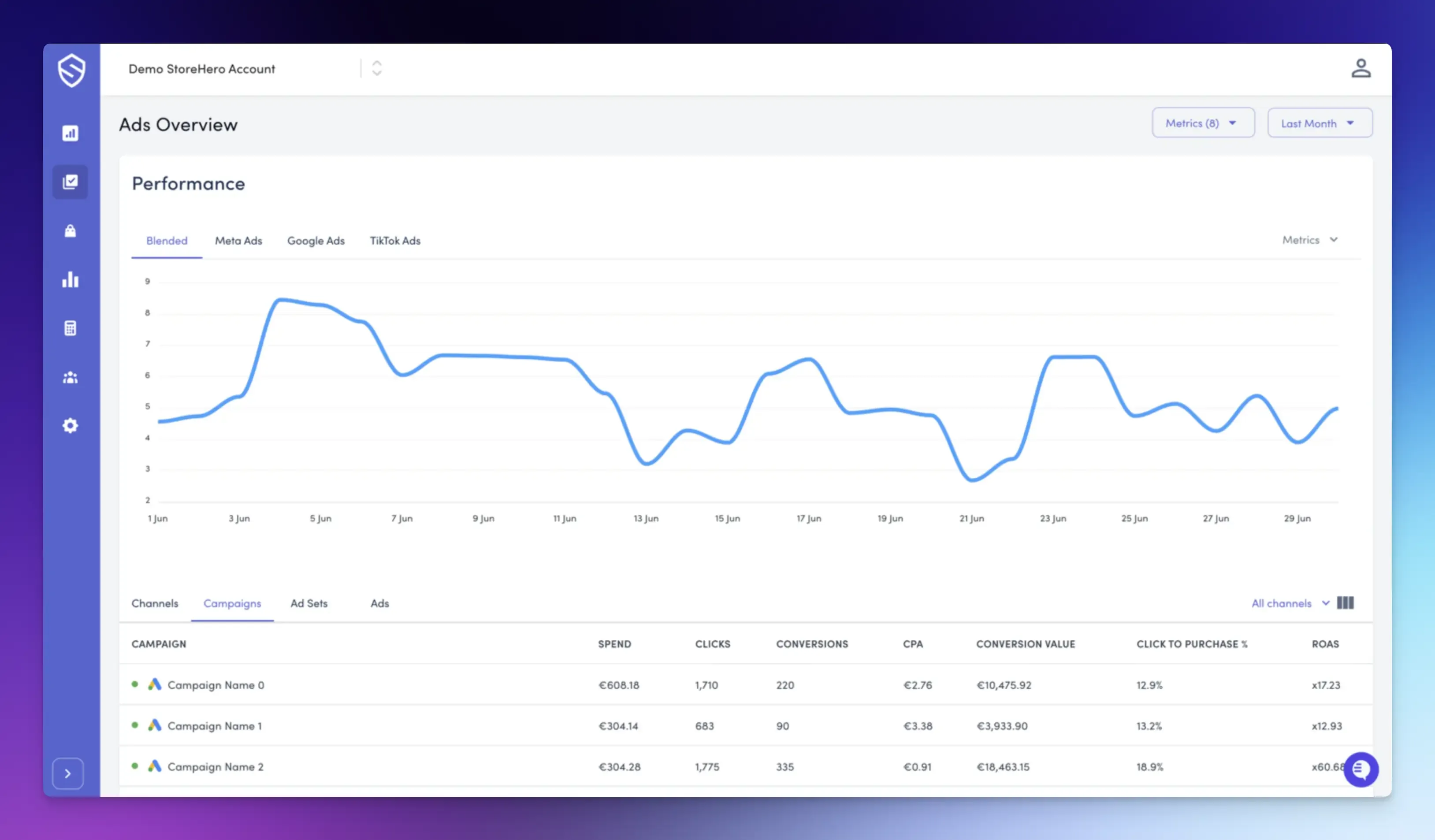
StoreHero is a profit-focused analytics platform for growing ecommerce brands. It combines your sales data, product costs, and ad spend in a single dashboard to show your profit.
Best for: Shopify stores and growing DTC brands that want to see profit by channel and product.
Key features:
- Real-time profit dashboards that show contribution margin and lifetime value by customer group.
- Forecasting and goal tracking tools to plan profit growth.
- Spend Advisor shows how every dollar in ad spend affects profit.
Pros:
- Clear visibility into true profit rather than just revenue.
- Automatic connection of marketing, finance, and store data.
Cons:
- Designed for Shopify and similar platforms.
- Advanced forecasting depends on clean data inputs.
Pricing: Starts at $179/month and scales based on your store’s annual revenue.
Final Words
Ecommerce analytics is critical for online businesses that want to understand what is happening in their stores and how well their marketing efforts are working.
Whether you want to measure the real profit of every sale, understand your customer’s long-term value, or analyze user behavior on your website, there is a solution on this list for you.
Start by defining the single most important question you need answered about your business, and let that guide your selection.
FAQs
Yes, you don’t need advanced tools initially. Start with basic analytics and build from there as you grow.
It depends on your needs. Some brands start with a basic analytics tool, then add specialized platforms for behavior tracking, marketing attribution, or customer insights when they need more detail.
Ready to understand your users?
Start tracking